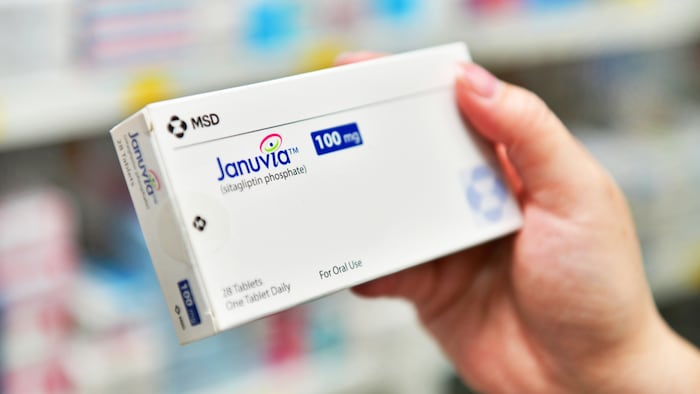
Dozens of sitagliptin generic brands are expected to swarm the Indian market in the days to come with Merck & Co., Inc.'s blockbuster diabetes drugs, Januvia (sitagliptin) and Janumet (sitagliptin/metformin hydrochloride) losing patent cover this month in the country.
The Januvia India Story
Merck’s blockbuster diabetes drugs, Januvia and Janumet have had an eventful journey in India, one that perhaps encapsulates what it takes to compete in a complex out-of-pocket emerging market.
From going through with a bold India-specific pricing approach for a patented drug way back in 2008 to fending off a local pre-expiry patent challenge after a fiercely contested legal battle, Januvia/Janumet now face an avalanche of cut-price generics coming their way following patent expiry this month in India.(Also see "Pre-expiry Januvia generics may test Merck’s resolve in India" - Scrip, 28 March, 2013.)(Also see "Merck Wards Off More Januvia Infringers In India" - Scrip, 5 November, 2015.)(Also see "MSD takes Glenmark to court over sitagliptin ’infringement’" - Scrip, 3 April, 2013.)
The diabetes therapies were among the early products that MSD introduced in 2008 in India at differential prices – Januvia was at the time said to be available at about INR43 per day in India, compared to around $5 a day (equivalent to INR200 then) in the US.
The strategy, was seen as game changer of sorts for Merck as it sought to expand access to the DPP-4 inhibitor in India, which currently has an estimated 74 million adults living with diabetes. The US firm also entered into a co-marketing arrangement with Sun Pharmaceutical Industries for the products to further propel these efforts.
The story behind the pricing stance for Januvia has some interesting nuances. The US firm apparently undertook multi-forked India studies on attributes of the product versus pricing covering diabetes patients, physicians and caregivers and did a price- volume analysis thereon that threw up interesting findings - the long-term sustainable price was seen to be in the range of around INR40-45.
While that was considered “the rock bottom story [ given the US, Europe prices of Januvia at the time]”, as one source in the know put it, what surprised the company was the level of shift that physicians were ready to make towards sitagliptin because of their style of practice which was, among other aspects, geared around minimizing the risk of hypoglycemia. With the DPP-4 inhibitor class offering a range of other benefits, physicians appeared ready to think about a price which was higher than the normal treatment cost and also perhaps saw the drug as “a bridge” between treatments available at the time and "insulinization".
Indications are that the Indian pricing plan took considerable convincing to do at the US firm - it is believed to have gone all the way to Richard Clark, chairman of Merck & Co at the time - and was finally green-lighted amid promise of sharp volumes and cumulative sales expectations of around $100m some years down the line .
“Never before had any diabetes product launch seen such sales volumes in India,” an industry expert recalled.
Sitagliptin Pre-Expiry Challenge
But in 2013, Merck appeared to have been caught off-guard when domestic company Glenmark introduced its cut-price version of Januvia and Janumet on the Indian market ahead of the expected patent expiry date. Glenmark’s brands Zita and Zita-Met were priced 30% lower. Scrip, at the time, was the first to report Glenmark’s actions.
While the Indian firm claimed that Zita and Zita-Met were "non-infringing", Merck said that it believed they “directly infringe” upon its intellectual property.
What followed was a high decibel court battle, with Merck asserting that as an innovative pharmaceutical company, protection of its intellectual property is vital to ensuring that “we continue to assume the tremendous monetary risks associated with the discovery of innovative medicines”.
The case went MSD’s way and in October 2015 the Delhi High Court issued a permanent injunction against Glenmark’s cut-price versions of Januvia/Janumet.(Also see "Permanent Indian Bar Against Glenmark’s Sitagliptin Copies" - Scrip, 8 October, 2015.) Among a string of observations, the judge held that MSD had succeeded in proving that the suit patent discloses sitagliptin phosphate monohydrate "generically."
Interestingly, 2015 also saw Glenmark launch another DPP-4 inhibitor teneligliptin, a cut-price version of Mitsubishi Tanabe Pharma Corporation's Tenelia, in India via a dual brand approach and at a price point that was approximately 55% lower than the other DPP4 inhibitors available in India at that time. (Also see " Glenmark 'pioneers' Mitsubishi's teneligliptin in India " - Scrip, 15 June, 2015.)
Among the first off the block is nemesis and past Januvia challenger, Glenmark Pharmaceuticals Limited, which has introduced the...