
Medtech Insight is honoring May and June awareness months for mental health, Alzheimer’s and brain health by speaking with industry leaders about rising innovations to address neurological diseases and mental health, the regulatory and investment climate, reimbursement, and more.
Though only 15, Chrissy had already lost hope. She was battling severe depression, and nothing she tried was working. And she had tried everything.
Her mother, Patricia, feared the worst.
“She didn’t want to come out of her room. She didn’t want to shower,” Patricia said. “It was very hard to see her struggling.”
After several traditional therapies, including medications, had failed, Patricia happened to catch a news segment on transcranial magnetic stimulation (TMS) therapy for depression.
Patricia immediately made an appointment at the nearest clinic that offered NeuroStar with a doctor and a week later took Chrissy for her first TMS treatment with the NeuroStar system, which was developed by Pennsylvania-based medical technology firm Neuronetics.
On Wednesday 15 May, Chrissy and Patricia joined Kenneth Pages, medical director of TMS of South Tampa, a psychiatrist who uses TMS in his clinical practice, and mental health advocate and NeuroStar patient Drew Robinson, at the Standard Hotel in New York for a NeuroStar sponsored event to celebrate Mental Health Awareness Month and the FDA’s recent expanded clearance of the device for treating adolescent patients.
At first, Chrissy said she did not notice any changes and was very anxious about receiving the treatment.
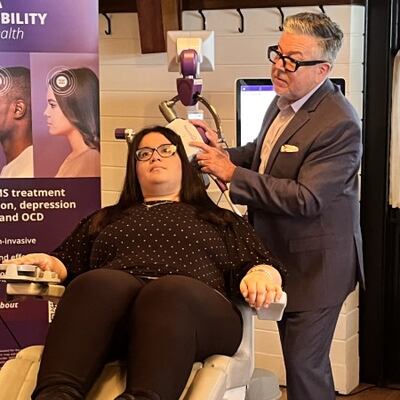
As Pages demonstrated prior to the event, the NeuroStar device — a cushioned set of coils — is placed against the brain during non-invasive treatment sessions that average around 19 minutes.
The system delivers magnetic pulses to stimulate nerve cells in the brain that regulate mood.
Pages explained during his demonstration that depression, despite conventional wisdom, is not caused by a chemical imbalance. Rather, it is associated with disruptions in the brain’s circuitry, “which is where TMS comes in,” he explained, likening the need for daily treatments to pulling the cord of a lawn mower to get it started.
“It won't start right away,” he said. “You have to keep pulling repeatedly until the engine gets going. You can think of TMS as doing a similar thing to the brain’s circuitry.”
Pages said the recommended regimen with the system is 36 treatments.
“I know there are more teenagers who can be saved with this treatment. It saved my life. I know it can save the life of someone else my age.” — Chrissy
For Chrissy, it was during her third week of treatment that the engine — to use Pages’ metaphor — finally turned over.
“I started feeling wonderful. I didn't feel sad and hopeless all the time,” she said. “And when I finished the six weeks of treatment, for the first time in my life, and I'm only 15 years old, I saw true hope. If it wasn’t for NeuroStar, I wouldn't be here today.”
A Higher Bar
Though the US Food and Drug Administration had already cleared the NeuroStar system for treating adults, getting the agency to extend that clearance for adolescents was a much tougher sell, as Neuronetics CEO Keith Sullivan explained during the presentation.
Over the past 14 years, NeuroStar has delivered more than six million treatments to 175,000 patients, Sullivan said, including 8,500 adolescents that were treated for depression off label.
However, when the company took samples of that data to the FDA to substantiate its request for the extended clearance, Sullivan said the agency’s answer was a “hard no.”
“What we found out is that adolescents are a protected class to the FDA, so the bar to get a clearance for that group is much higher,” he said. “So, we went back, and we put our data together and we also supplemented it with thousands of patients that were treated in a clinical trial outside the United States.”
Nine months later, Sullivan said, it paid off.
In April, the FDA extended the clearance for younger patients. (Also see "Neuronetics Gets Expanded Clearance For TMS Therapy System" - Medtech Insight, 1 April, 2024.)
What convinced the FDA, according to Sullivan, was real-world data collected in the company’s proprietary TrakStar platform, which revealed the safety and efficacy of the treatment in adolescent patients.
Of the 1,169 adolescents treated with NeuroStar, Sullivan noted, 78% achieved clinically meaningful improvement in their depression severity when used as an adjunct to antidepressant therapy versus using antidepressant therapy alone.
“People would rather hear from you, than hear about you.” — Drew Robinson
The FDA also extended the clearance as a first-line treatment, meaning adolescent patients can receive NeuroStar prior to other therapies.
“This is a major step for patients like Chrissy battling depression who have no other option,” Sullivan said.
Everything To Live For
In April 2020, panel member Robinson, 29 at the time, miraculously survived a self-inflicted gunshot wound to his head. Though he lost an eye, he gained a renewed desire to live.
Despite being drafted by the Texas Rangers in 2010 and fulfilling his dream of playing professional baseball, Robinson said the reality of his life resembled nothing as it appeared on the surface.
“On paper, I was living the life that I had always dreamed of. But I was still struggling with deep-rooted confusion and was feeling awful all the time,” he said.
Then, when COVID-19 hit, forcing him into quarantine, his mental health struggles deepened.
Amid a personal breakup, Robinson said he was not being completely honest with his therapists, partly because he was afraid of being judged or misunderstood. How could someone with his life — the one on paper — have such deep-seated struggles and depression?
“And so, I convinced myself that life wasn't worth living anymore.”
Now, a mental health advocate who works with other professional athletes, Robinson said his NeuroStar treatments have been an essential part of his continued recovery.
“I was introduced to NeuroStar and had a very similar experience as Chrissy,” he said. “I'm so thankful I was able to find it. I'm very grateful, not only to be here, but to be able to be here and to talk about my experience.”
He also emphasized the importance of those with thoughts of self-harm to talk to someone and not remain silent.
“I’ve learned that people would rather hear from you, than hear about you,” he said.
Depression, Pages said, especially among adolescents, has only increased in the age of social media and was further heightened during the pandemic. TMS therapy, Pages added, has the potential to transform depression treatment for youth.
In 2021, 9% of high school students in the US reported attempting suicide during the previous 12 months, according to the Centers for Disease Control and Prevention, which lists suicide as the third-leading cause of death among high school-aged youths.
Pages also stressed the need for parents to talk to their children about mental health and listen to what they say.
“These are not easy conversations,” he said, “but if an effort is made, then you can go forward from there.”
Chrissy agreed:
“I believe that mental health should be talked about more with adolescents. And it's important that we pay attention to their warning signs,” she said. “My mom noticed right away that I was feeling down and she took action immediately. I know there are more teenagers who can be saved with this treatment. It saved my life. I know it can save the life of someone else my age.”