
Uncertain Times: New Lockdowns, Ukraine Challenge Chinese Pharma

As residents of China's largest city brace for a possible prolonged lockdown, the gathering COVID-19 outbreak is set to cause some pharma disruption in the country, while broader geopolitical factors including Ukraine are hindering the industry's global ambitions. 

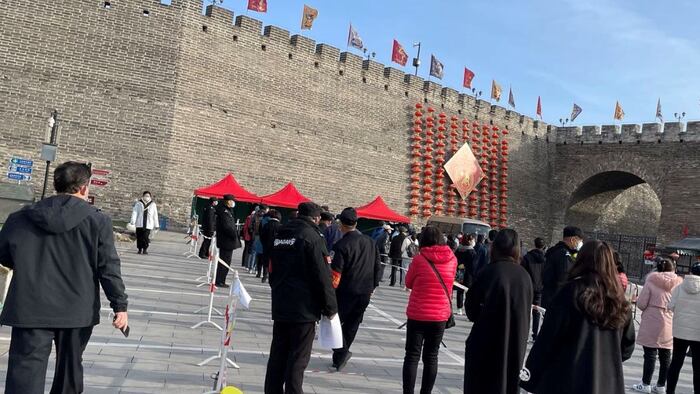
Beijing residents waiting in line to get PCR Testing on March 21 morning.
BEIJING RESIDENTS WAITING TO GET PCR TESTING ON 21 MARCH 2022 • Source: Brian Yang/Scrip

Going into the third year of the global pandemic, residents of China's largest city are feeling uncertainty around potential extended lockdowns for the first time, the impact of which could affect a major research and headquarters hub for the pharma industry in the country.

Shanghai is reporting record numbers of COVID-19 infections, official data pointing to 977 asymptomatic cases and four confirmed infections as...

Scrip Podcast

Keep up with the top pharma business news of the week. On the go.

Scrip brings you a weekly bulletin of top picks.

More from China

  • Iran Deal In Place, But API Prices Stay Elevated And Pharma Supply Chains Face A Slow Recovery

    A framework to end the Iran war is in place but fractured supply chains can’t recover overnight. Data from India suggests solvent prices have generally cooled from April peaks, but API costs stay elevated or even climbed in June for some products.

  • Embracing China’s Brave New Pharmaceutical World!

     
    • By 

    Already one of the world’s largest pharmaceutical markets, China has tremendous growth potential, but significant policy and market changes are rocking the basis of competition. Multinational biopharma corporations cannot succeed in this new environment unless they fundamentally reinvent their business models to adapt to sweeping change.

  • Spotlight On RDCs, AOCs As Leading Novel Bioconjugates[Updated]

    Pipelines in bioconjugates continue to develop, from ADCs to XDCs, with radionuclide drug conjugates (RDCs) and antibody-oligonucleotide conjugates (AOCs) leading the expansion.

  • Fosun ALK/ROS1 Inhibitor Shows 1L Promise In Advanced NSCLC

    Interim results from the Phase III REMARK study presented at WCLC showed the Chinese company’s second-generation ALK/ROS1 inhibitor met its primary endpoint as a first-line therapy in ALK-positive advanced NSCLC.

More from Focus On Asia