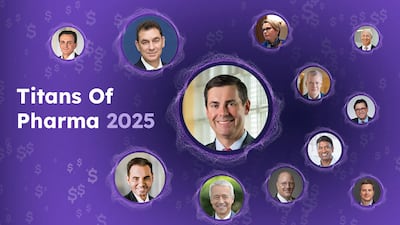


Riding high on the wave of its dual GIP/GLP-1 agonist, tirzepatide, Eli Lilly awarded its CEO the highest total remuneration package of the top 12 big pharma companies in 2024. David Ricks’s total compensation rose by 10% to $29.2m in a year when Lilly’s revenues grew by 32% to $45.0bn, driven by its two tirzepatide products, Mounjaro for diabetes and Zepbound for weight management. The company is expecting sales to rise a further 29%-36% to $58bn-61bn in 2025.
AbbVie And Pfizer Also In Top Three
Key Takeaways
- Lilly’s David Ricks received the highest total compensation among the top 12 pharma companies in 2024, with the company enjoying strong growth recently and good prospects thanks to its GIP/GLP-1 obesity and diabetes products.
- Lars Fruergaard Jørgensen had the most modest compensation package of his peer set, and is set to be replaced at the helm of Novo Nordisk amid concerns over apparent missed opportunities to sustain its phenomenal GLP-1-fueled growth.
- Average CEO remuneration remained around the same level as in 2023.
- CEOs of five US companies occupied the top spots for compensation, while the bottom four places were all European CEOs.
Johnson & Johnson CEO Joaquin Duato, who topped the table for 2023 compensation, saw his package slip by 14%, pushing him down to fourth place behind AbbVie’s Richard Gonzalez (who retired on 1 July 2024) and Pfizer’s Albert Bourla, who enjoyed increases of 11% and 14%, respectively. J&J is grappling with the loss of US market exclusivity of its multi-blockbuster Stelara from early 2025 and will also be impacted by the Medicare Part D redesign, under which three of the first 10 drugs up for price negotiation are J&J products.
In second position, AbbVie’s Gonzalez booked $28.5m, although he retired in July 2024, assuming the position of executive chairman. Robert Michael, who had previously served as president and chief operating officer, was promoted to CEO, receiving total compensation of $18.5m. Gonzalez will stand down as chair in July 2025, when Michael will assume that role too.
Bourla, in third place for overall compensation, oversaw 4.8% revenue growth at Pfizer in 2024, when the company was the world’s biggest by pharma sales, at $62.4bn. However, Pfizer has faced grumbling from activist investors over returns on R&D and M&A investment. With a number of market exclusivity expiries over the next five years expected to cost it billions of dollars of revenues, the firm has been cutting internal R&D and pursuing acquisitions. In April it re-affirmed full-year revenue guidance of $61bn-64bn, although this excluded any potential impact from tariffs or trade policy changes.
Compensation Stagnates As Pharma Sales Rise
While five CEOs received increased compensation, a majority saw their total remuneration decline in dollar terms in 2024, although for certain executives like Roche’s Thomas Schinecker, who is paid in Swiss francs, the local currency payout was higher. And at Bristol Myers Squibb, the comparison was between Chris Boerner in his first full year in the role, and Giovanni Caforio’s total compensation in 2023. Caforio retired on 1 November 2023, handing over to chief operating officer Boerner, who received total 2023 compensation of $8.5m.
In fact, the mean compensation package stayed virtually flat in the big pharma peer set in 2024, at $19.4m compared with $19.3m in 2023. Over the same period, the total sales of the top 12 companies rose by 9% to $617bn, with Lilly growing the fastest, followed by Novo Nordisk at 24.9% (in dollar terms) and AstraZeneca at 23.5%. Only Novartis experienced a decline in revenues, although this reflected the spinout of its Sandoz generics and biosimilars business and masked a 12% growth in net pharma sales.
Looking forward, predicted sales growth according to sell-side analyst consensus data from Evaluate Pharma (based on total worldwide prescription and OTC drug sales) shows Lilly and Novo Nordisk with the strongest future prospects. But while Lilly’s CEO topped the 2024 compensation table, Novo Nordisk’s Lars Fruergaard Jørgensen occupied bottom place among the top 12 pharma companies.
In May 2025 Jørgensen was forced out by controlling shareholder Novo Nordisk Foundation, with a falling share price and other “recent market challenges” behind the call for change. He remains in post while the search for a new CEO takes place. Although Novo’s sales have shot up in recent years thanks to the success of its GLP-1 receptor agonist, semaglutide, branded as Ozempic for type 2 diabetes and Wegovy for obesity, preparations for maintaining the revenues have drawn criticism: the company missed a beat when its follow-on combination product CagriSema failed to deliver outstanding results in Phase III, whereas Lilly’s investigational oral GLP-1 orfoglipron looks to have high potential. The company had also downgraded its 2025 forecast earlier in the month.
Both Lilly’s 2024 CEO compensation and its 2024-2029 revenue growth forecast of 139% positioned the company at the top of its peer set, but the correlation between the two metrics was weak among the big pharma group overall. AbbVie’s high executive remuneration was almost mirrored by its third place in the growth forecast at 36%, whereas Pfizer, in third place for executive compensation, had the second-lowest outlook with 2029 drug sales expected to be around the same as in 2024. And while Roche is predicted to experience the fourth-highest sales growth among the 12, driven in particular by Vabysmo (faricimab) for wet age-related macular degeneration and other ophthalmology indications, CEO Schinecker received the third-lowest compensation package in 2024.
The US CEO Premium
As the chart above shows, 2024 executive compensation was more aligned with geography than revenue prospects: CEOs of European companies (in teal) had average compensation of $14.1m while their companies had a mean forecast growth of 28.5%; CEOs of US companies (in purple) had average compensation of $24.8m while their companies had mean forecast growth of 30.5%. Excluding the outliers Lilly and Novo Nordisk, the growth/compensation comparisons were 18%/$15.3m for European companies and 8.8%/$23.9m for their US counterparts.
Although European CEOs generally received less generous packages than their US counterparts, Novartis’s Vas Narasimhan and AstraZeneca’s Pascal Soriot were both ahead of BMS’s CEO Boerner. Admittedly, Boerner was new in the role, and the company’s five-year outlook was the worst of the group, with a 22% drug sales drop predicted as the company’s PD-1 inhibitor Opdivo (nivolumab) faces likely loss of exclusivity in the US in 2028. In contrast, AstraZeneca is forecast to grow by 20% and Novartis by 15% over the same period.
The situation was similarly stark looking at actual net income for 2024.
European Bang For The Buck
The chart above maps executive compensation against 2024 net income. For correlation between the two, companies would be positioned along a line cutting through the bottom left and top right quadrants.
Companies in the top left quadrant represent those where the CEO provides more bang for the buck, where bang = net income, while those in the bottom right quadrant were relatively costly for the income generated. The chart shows that once again, European CEOs on average provided more value for money than their US counterparts.
Our final analysis looked at total shareholder return (dividends plus capital growth per share) in the one, three and five years to the end of 2024.
Lilly Surges, Novo Falters
Lilly’s Ricks, who was appointed CEO in 2017, has overseen a period of strong value growth for investors, with the company comfortably beating its peers over each of the three periods under consideration. And while Novo Nordisk’s Jørgensen can boast a strong record compared with three and five years previously, more recently the tide has turned. Novo’s total shareholder return (TSR) declined by 9% in 2024, the largest fall of any of the big pharma peer group.
While shareholders in any of the top 12 companies will have enjoyed growth over three and five years, it was bad news over the shorter term for investors in Merck & Co, Johnson & Johnson and GSK, whose stock price declines over 2024 were only partially offset by dividend payouts.
Aside from Lilly, the best TSR over one year was provided by AbbVie at 19% and BMS at 15%, while Sanofi and Roche also enjoyed share price growth over 2024. Other companies were only able to provide growth (or stability) for investors through their dividends, with the share prices of seven of the 12 companies ending 2024 below their closing prices at the end of 2023.
Editor’s notes: CEO compensation covers all elements as reported to the SEC, including but not limited to base salary, bonus, pension plan and short and long-term incentives (including equity awards). All currencies have been converted to US dollars using rates from 31 December 2024 to enable comparison between companies.